U.S. flag

An official website of the United States government, Department of Justice.

Drugs

Fighting the Opioid Crisis

Convening Police Leaders and Researchers to Learn Promising Practices and to Inform Research Agenda

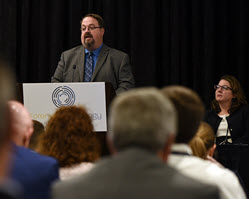
Director Muhlhausen's prepared remarks at the NIJ-hosted Opioid Research Summit.

NIJ Director David B. Muhlhausen at the podium

NIJ Director Muhlhausen

Good morning and welcome to Washington, DC. It’s a privilege to host you here today at the National Institute of Justice. I’m particularly honored to have the Attorney General and the Principal Deputy Assistant Attorney General with...

2019 National Opioid and Emerging Drug Threats Policy and Practice Forum

Dr. Muhlhausen's remarks at the 2019 National Opioid and Emerging Drug Threats Policy and Practice Forum, which built off the momentum of the widespread stakeholder meetings convened to discuss the consequences of this national epidemic, including the impact it has had on public safety, public health, and the criminal justice response.

Good morning!

Thank you all for coming here so early, and in many...

Addiction, the Brain, and Evidence-Based Treatment

March 2012

The criminal justice system encounters and supervises a large number of drug abusing persons. Punishment alone is a futile and ineffective response to the problem of drug abuse. Addiction is a chronic brain disease with a strong genetic component that in most instances requires treatment. Involvement in the criminal justice system provides a unique opportunity to treat drug abuse disorders and related health conditions, thereby improving public health and safety.

Seized Drugs/Controlled Substances

Controlled substances are chemicals that have a legally recognized potential for abuse. They include “street drugs” such as heroin or ecstasy and prescription drugs such as oxycodone. Detecting and identifying controlled substances is a critical step in law enforcement's fight against drug-related crime and violence.

On this page, find links to articles, awards, events, publications, and multimedia related to controlled substances and seized drugs.

Sex Offenders in the Community: Post-Release, Registration, Notification and Residency Restrictions

May 2010

The management of sexual offenders in the community post-release is an issue of increasing concern to law enforcement, policymakers and the public. In recent years, efforts to strengthen registration and notification have been enhanced. At the same time, comparatively little attention has been paid to related matters, such as how residency restrictions may impact offenders' efforts to find stable work and living arrangements once they are released from prison, whether rates of recidivism have changed, and whether these policies increase the safety of potential victims.

Drug Courts

Drug courts are specialized court docket programs that target criminal defendants, juveniles who have been convicted of a drug offense, and parents with pending child welfare cases who have alcohol and other drug dependency problems.

On this page, find links to articles, awards, events, publications, and multimedia related to drug courts.

Drugs and Crime

The National Institute of Justice sponsors research on alcohol and other drugs in the context of juvenile and criminal justice systems to promote effective law enforcement, court, and corrections responses to illegal drug markets and criminal behavior related to illicit drug use.

NIJ's drugs and crime research informs crime reduction through several approaches:

  • Epidemiology — to identify patterns between drugs, violence, and crime to...

Crime File: Drug Testing

January 1986

In this Crime File video, James Q. Wilson moderates a panel of three (Jay Carver, Director of the D.C. Pretrial Services Program; Elizabeth Symmonds, attorney with the Capitol Area Affiliate of the American Civil Liberties Union; and Dr. Eric Wish, a drug researcher)

Crime File: Drug Trafficking

January 1986

In this Crime File video, James Q. Wilson moderates a panel of three (Mark Kleiman, Harvard University Research Fellow; Mark Moore, Harvard University Professor; and John Lawn, Administrator of the United States Drug Enforcement Agency), this team discusses Federal and local enforcement strategies against drug trafficking.