Violent crime
Assessing the Impact of an Innovative Response to Intimate Partner Violence Related Strangulation, Final Report & Outcome Evaluation
Oklahoma Methamphetamine Data Initiative: Final Research Report
Addressing the Challenges of Drug-Facilitated Sexual Assault
Addressing the Challenges of Detecting Drug-Facilitated Sexual Assault
NIJ has funded research to address the challenges of detecting DFSA for several years. This research includes projects that examine ways to improve forensic hair testing and how drugs modify blood proteins.
Improving Sexual Assault Kit Outcomes
Researchers have identified connections between the development of a CODIS-eligible DNA profile and attributes associated with sexual assault victims and assault characteristics.
Intent vs Impact: A Qualitative Investigation of Domestic Violence and Extreme Risk Protective Order Gun Prohibitions in Two States
The Prevalence and Nature of Victimization among First Semester Students at Urban, Hispanic-Serving Institutions (HSIs)
Preventing Relationship and Sexual Violence on College Campuses
Safe Transitions for Teens
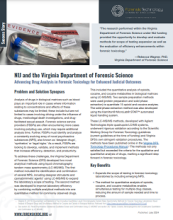
Success Story: NIJ and The Virginia Department of Forensic Science Advancing Drug Analysis in Forensic Toxicology for Enhanced Judicial Outcomes
COVID-Related Financial Issues Experienced by Women-Identifying Survivors of Intimate Partner Violence
The Lethality Assessment Program 2.0: Adjusting Intimate Partner Violence Risk Assessment to Account for Strangulation Risk
Assessment of Sexual Assault Kit (SAK) Evidence Selection Leading to Development of SAK Evidence Machine-Learning Model (SAK-ML Model)
Understanding the Impact of COVID-19 on Victim Services
Reducing Gun Violence Through Integrated Forensic Evidence Collection, Analysis, and Sharing
Multi-pronged approach of data integration, collaboration, and intelligence-led policing has helped reduce gun violence in New Jersey.